Food
China Street Food & Night Markets: City Routes, Stall Evidence & Safer Ordering
Turn a street-food clip into the right Chinese market, street, or stall — with city-specific routes, bilingual map identities, ordering recovery, and food-safety boundaries.
China Travel Made Easy concierge desk · Last updated · 8 primary sources checked
Decision first
What should I do?
- Best for
- Travelers turning a TikTok, Instagram Reel, or guide recommendation into a realistic street-food stop in Xi'an, Kaifeng, Chengdu, or Shanghai.
- Do this
- Save the district or market as a route anchor first; add an exact stall only when its official Chinese storefront, city, address or branch, and source evidence agree. Order one portion, confirm the unit and total, and favor food cooked fully and served steaming hot.
- Watch for
- A dish name is not a vendor, a market pin is not a stall, a queue is not proof of hygiene, and a creator's price, safety, or allergy claim does not automatically transfer to the place.
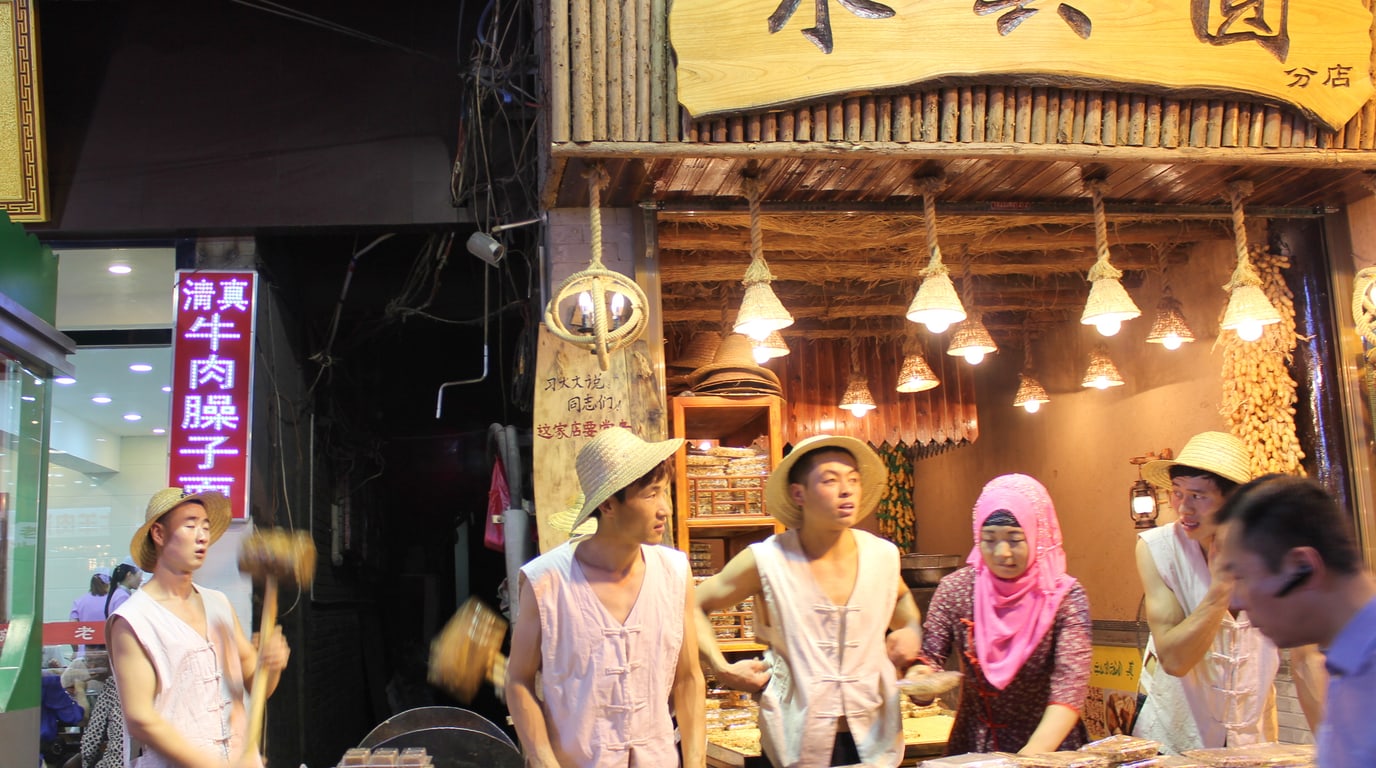
Street-food planning breaks when a memorable dish is treated as if it were an address. A clip can prove that a creator ate something in Xi’an; it does not necessarily prove which branch, which entrance, whether the cart still operates, or whether the same-looking AMap result is the one in the video.
The useful workflow is:
dish idea → city route → exact storefront evidence → bilingual map match → ordering and payment fallback
That distinction matters more than a universal “best night markets” list. The four examples below are intentionally different: a cultural district, an operating night market, a commercial food cluster, and a heritage snack area.
Classify the object before you save it
| What the source actually identifies | Example | What belongs on the map |
|---|---|---|
| Dish idea | “Try jianbing in Xi’an” | Keep 煎饼 in the trip notes; do not invent a vendor |
| Market or street route | “We spent the evening around Gulou Night Market” | Save 鼓楼夜市, with operating time to reconfirm |
| Named storefront, branch unclear | A chain logo is visible but the mall or district is missing | Keep as probable; ask which branch |
| Resolved stall or shop | Chinese storefront, city, address, and source evidence agree | Save the exact place with its source and checked date |
Do not “improve” an unresolved clip by attaching it to the most famous result for that dish. That creates a confident-looking false pin and teaches every later user the wrong identity.
For each exact vendor, retain:
Source URL and creator:
Claim, caption, or transcript excerpt:
Dish — English / Chinese:
Market or street — English / Chinese:
Vendor — English / official Chinese storefront:
City, district, and address:
Visible branch, unit, floor, or landmark:
Map result and date checked:
Price shown by source and source date (not a universal price):
Resolution: resolved / probable / unresolved
Four city routes that are not interchangeable
Xi’an: a street network, not “the roujiamo pin”
Xi’an Muslim Quarter / 西安回民街 is a useful orientation anchor for the connected streets around Beiyuanmen and the Drum and Bell Tower area. It is not one market operator and it does not resolve an individual stall. Xi’an’s own planning material treats Beiyuanmen and Sajin Bridge as parts of a larger historic urban fabric; current city recommendations also name Sajin Bridge / 洒金桥 as a separate food route.
Start with the district anchor, then save exact shops only after reading the Chinese storefront. In this Hui context, look for 腊牛肉夹馍 (cured beef in bread), 牛羊肉泡馍 (beef-and-lamb paomo), skewers, sesame sweets, and persimmon cakes. Do not send a traveler to a Muslim storefront for the pork-filled 腊汁肉夹馍 commonly associated with Shaanxi cooking elsewhere. “Roujiamo” alone is still only a dish category.
Use Sajin Bridge Food Street / 洒金桥美食街 as its own route anchor rather than claiming it is simply a cheaper clone of the main street. Source-posted prices age quickly; compare a specific item, portion, and date instead of promising that prices drop after an arbitrary walk.
Kaifeng: an actual night-market operating context
Gulou Night Market / 鼓楼夜市 is the strongest example here of a named night-market route. Kaifeng’s 2026 public information still treats Gulou and Xisi night markets as core night-economy landmarks and describes price, ordering, and food-safety oversight.
That official status does not mean every stall is permanent or equally controlled. Confirm the day’s opening time at the hotel or on the current map listing, arrive with several small dishes in mind, and preserve a vendor’s visible number or Chinese name if you want to return. A cart position is weaker identity evidence than a fixed storefront.
If a video says only “Kaifeng night market,” do not automatically assign Gulou: ask whether it was 鼓楼夜市 or 西司夜市, then use storefront and landmark evidence to resolve the exact stop.
Chengdu: a famous commercial cluster, not a secret local street
Jianshe Alley / 建设巷, near the broader Jianshe Road / 建设路 area, is a popular food cluster northeast of central Chengdu. Official tourism material calls it Jianshe Alley Night Market; recent city coverage continues to include Jianshe Road in recommended food-district routes.
Treat it honestly: it is a well-known, renovated, social-media-friendly commercial destination. That can make it useful for a concentrated tasting walk; it does not make every viral stall exceptional or permanent. Resolve the alley first, then decide whether the clip contains enough storefront, queue-number, unit, or address evidence for a vendor pin.
Many Chengdu dishes carry hidden choices—chili level, serving size, meat, stock, toppings, or whether the quoted price is per skewer or portion. Show the vendor the menu photo and confirm the final amount before paying.
Shanghai: a heritage snack route, not a night market
Shanghai City God Temple / 上海城隍庙 and the adjacent Yu Garden area form a tourist-facing heritage snack route. Shanghai’s municipal guide describes a roughly three-kilometre food line through the City God Temple and Yu Garden area with old brands, xiaolongbao, and vegetarian buns.
Save it for what it is: a convenient historic-area tasting walk with recognizable shops. Do not relabel it a local night market, promise bargain pricing, or treat a long queue as quality or safety proof. For a famous shop, preserve the exact branch and floor—searching only 城隍庙 resolves the district, not the restaurant in the video.
Order one item without losing control of the bill
Pointing is useful, but it does not settle quantity, unit, spice, or total. Use this sequence:
- Point to the item, menu image, or the exact tray—not merely the general counter.
- Show
1on your phone and the text一份(one portion). For skewers, confirm whether the displayed price is per skewer, set, or weight. - If needed, show
不要辣(no chili) or少辣(less chili). Treat this as a preference request, not an allergy statement. - Ask the vendor to show the total on a calculator or payment screen before you confirm.
- Order one portion first. A tasting route works better when one uncertain dish does not consume the whole appetite or budget.
QR payment is common, but “every cart accepts every foreign-linked wallet” is not a dependable rule. Keep both a mobile wallet and RMB cash. The State Council’s visitor guidance says cash remains accepted; a small-note fallback is useful when a personal QR code, network, linked card, or app screen fails.
Use food-safety evidence, not vibes
A crowd can indicate demand and faster turnover. It cannot reveal whether hands were washed, cold ingredients stayed cold, water is safe, meat reached a safe internal temperature, or the same oil and utensils touched an allergen.
The CDC’s traveler guidance gives a more useful visible boundary:
- favor food cooked fully and served steaming hot;
- avoid raw or undercooked meat, seafood, and eggs when controls are uncertain;
- avoid cooked food that has been sitting lukewarm;
- choose fruit you peel yourself and factory-sealed drinks;
- use sealed bottled or adequately boiled water where tap-water safety is uncertain.
This reduces risk; it does not certify a vendor. Spice, unfamiliar richness, and infection are also not the same problem. Do not pre-medicate or carry unspecified “stomach medicine” as a substitute for food, water, and medical judgment.
For celiac disease, severe allergy, or another medical restriction, a street stall is often the hardest environment in which to verify sauces, stock, shared oil, utensils, and cross-contact. Use the food ordering and dietary guide and your clinician-reviewed plan. If the vendor cannot understand and confirm the boundary, leave.
Before leaving a useful field note
A community contribution should help the next traveler execute, not just repeat “must visit.” Record:
- visit month and approximate time;
- resolved Chinese place identity or an honest unresolved label;
- what you ordered, including portion and price on that date;
- how ordering and payment actually worked;
- whether the stall was fixed or mobile;
- what failed or differed from the video;
- the creator’s actual conclusion in their own context, without reducing it to a detached rating;
- context such as solo, family, mobility, budget, vegetarian, or medical restriction.
Keep the creator’s claim and your observation separate. A video supplies evidence; the map identity makes it executable; a dated visit tells the next traveler whether the handoff still survives contact with the street.
From guide to map
Review the places from this guide
We keep the Chinese name and city together so you can verify the right branch before opening AMap, Apple Maps, or Didi.
-
Xi'an Muslim Quarter / 西安回民街
Xi'an · Orientation anchor for a network of streets around Beiyuanmen; not an exact stall or a safety claim
-
Sajin Bridge Food Street / 洒金桥美食街
Xi'an · Separate Xi'an food route; verify the individual storefront before saving a vendor
-
Gulou Night Market / 鼓楼夜市
Kaifeng · Night-market route anchor; confirm current operating time locally
-
Jianshe Alley / 建设巷
Chengdu · Popular commercial food cluster near Jianshe Road, not a single venue
-
Shanghai City God Temple / 上海城隍庙
Shanghai · Heritage snack-area anchor by Yu Garden; not a night market or proof of local pricing
Frequently asked questions
- How do I turn a TikTok or Instagram street-food video into a map pin?
- First decide whether the clip identifies only a dish, a market or street, or an exact stall. Save a stall only when the visible Chinese storefront name, city, address or branch, and source evidence agree with the map result. Otherwise keep the dish as an idea or the market as a route anchor and label the vendor unresolved.
- Is a busy street-food stall safe?
- A queue can suggest turnover, but it cannot show water quality, refrigeration, internal temperature, or cross-contact. CDC traveler guidance favors food cooked fully and served steaming hot, fruit you peel yourself, and factory-sealed drinks; avoid raw, undercooked, or lukewarm food when controls are uncertain.
- How do I order and pay without speaking Chinese?
- Point to the item or a menu photo, show the quantity, and confirm the unit, number of portions, and total on a calculator before paying. Mobile wallets are useful, but keep RMB cash as a fallback; Chinese guidance says cash remains accepted. If the QR code or linked card fails, ask the vendor to enter the amount or use the other payment method.
- What should I eat in Xi'an's Muslim Quarter?
- Treat the quarter as a Hui food district and street network, not as one restaurant. Beef or lamb roujiamo (腊牛肉夹馍), beef-and-lamb paomo (牛羊肉泡馍), skewers, and sweets fit that context. Shaanxi's pork-filled lazhi roujiamo (腊汁肉夹馍) is a different dish to seek outside a halal or Muslim storefront.
- Can I eat street food with celiac disease or a severe allergy?
- Do not infer suitability from translation, popularity, or a creator's claim. A small stall may be unable to verify sauces, stock, shared oil, utensils, or cross-contact. Follow your clinician-reviewed plan and chef card; if the vendor cannot confirm the medical boundary, do not order.
Sources checked
We use official or first-party sources for rules and fast-changing product details. Community reports shape the failure-mode advice, not the underlying policy.
- CDC Yellow Book — food and water precautions for travelers
Checked July 12, 2026
- State Council — 2025 guide to working and living in China
Checked July 12, 2026
- Xi'an municipal government — city food-route recommendations
Checked July 12, 2026
- Xi'an historic-city plan — Beiyuanmen and Sajin Bridge context
Checked July 12, 2026
- Kaifeng city credit office — 2026 night-market operations and oversight
Checked July 12, 2026
- GoChengdu — Jianshe Alley Night Market
Checked July 12, 2026
- Chengdu city news — 2026 food-district route including Jianshe Road
Checked July 12, 2026
- Shanghai municipal government — City God Temple and Yu Garden food route
Checked July 12, 2026