China Travel Made Easy
All destinations

City

Pingyao

An intact county-town system of walls, lanes, civic institutions, merchant finance, courtyard life, and two outlying temples

Pingyao is more than a photogenic old street. Its value comes from reading defense, government, commerce, ritual, and domestic life as one preserved urban system—then completing the World Heritage story at Shuanglin and Zhenguo temples.

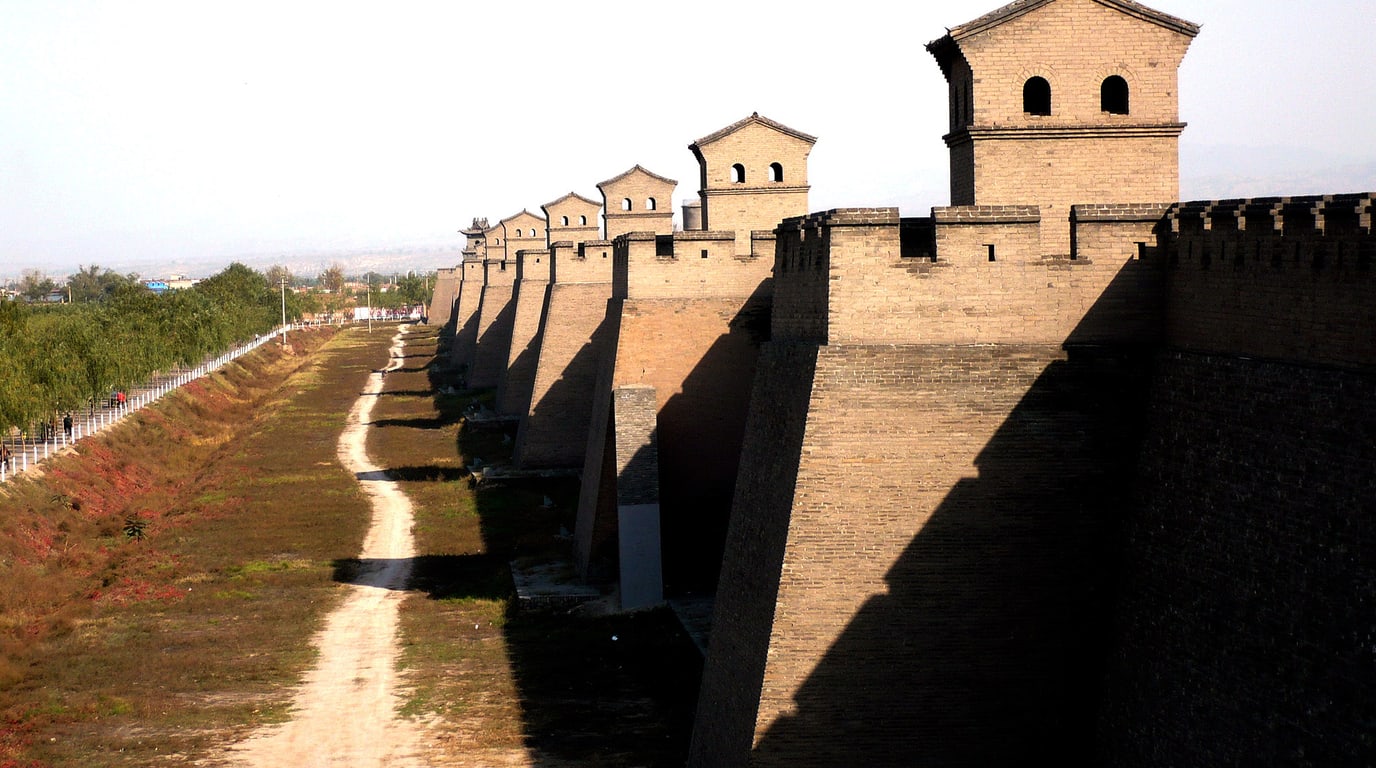
Brick rampart and watchtowers along Pingyao city wall
Cover source: Pingyao city wall

Destination digest

Pingyao, beyond the checklist

Pingyao becomes much richer once it stops being an “ancient town” backdrop. Read the wall, magistrate’s compound, financial houses, temples, shops, residences, and lanes as the machinery of a county seat; then travel beyond the wall to the two temples that complete the World Heritage property. Three days lets the city remain inhabited instead of becoming a costume-photo checklist.

Useful minimum
Three days: institutions, inhabited lanes, then one city–two temples with secured transport
Best first base
Inside the wall for early and late walks only after the hotel confirms the usable gate and luggage handoff
Arrival rule
平遥古城站 is the high-speed station; 平遥站 is a separate conventional station closer to the wall
Ticket rule
Public streets are free to enter; ticketed interiors and the two outer temples keep current, separate access terms
World Heritage rule
The property is the walled city plus 双林寺 and 镇国寺—not one central old-town pin
Video-to-map rule
Resolve the exact gate, courtyard, former bank, temple, hotel, performance, or restaurant branch

Read a county town, not a theme-park street

The old city is a complete spatial argument: the wall defines defense; 平遥县衙 makes county government tangible; 日昇昌 and neighboring financial houses explain the merchant economy; the Confucian and City God temples express civic and ritual order; lanes, courtyards, workshops, and homes preserve the domestic city between them. South Street is only one commercial spine. Keep leaving it for quieter east–west streets and residential lanes, and notice where heritage display, current business, rebuilt fabric, and ordinary life meet rather than calling everything “Ming and Qing.”

Arrival: 平遥古城站 and 平遥站 are not the same station

平遥古城站 is the high-speed-rail station southwest of town on 文景大道. 平遥站 is the older conventional-rail station near the northwest side of the old city. Save the exact Chinese station printed on the 12306 ticket before choosing a hotel or ride. The high-speed station name sounds as if it is at the wall, but it still requires a last-mile transfer; the conventional station may look closer while serving a completely different train. Protect enough time for station scale, traffic, luggage, and the gate where the hotel can actually meet you.

Day one: follow the institutions that made the city work

Begin at 迎薰门, the south gate, to understand the wall and the north–south commercial axis. Continue to 平遥县衙 before the rooms lose their meaning in a late-day rush: the sequence of offices, court spaces, prison, residence, and service yards turns an abstract county administration into a physical system. Then cross to 西大街 and 日昇昌票号, using one well-read financial house to understand remittance, accounting, trust, staff networks, and the wider merchant city. Finish with the public streets after the ticketed interiors close instead of treating night lighting as a substitute for them.

Day two: slow down enough to see the inhabited fabric

Use the second day for the city between headline sites. Walk one wall section only when the current entrance and weather make it worthwhile, then choose one or two institutions—文庙, 城隍庙, a courtyard, another financial house—rather than repeating similar displays until they blur. Spend the remaining hours on lanes away from the densest retail spine, observing courtyard thresholds, drainage, shop-house depth, building repair, resident access, and the way tourism shares a protected town with daily life. Early morning and the hour after ticketed sites close reveal a different city from midday groups.

Day three: complete “one city, two temples”

The World Heritage property is not just the area inside the wall. 双林寺, roughly six kilometres southwest, holds an exceptional ensemble of painted sculpture; 镇国寺, about twelve kilometres northeast, preserves the 963 Wanfo Hall and rare Five Dynasties fabric and sculpture. They point in opposite directions and are not a casual walk or one map cluster. Arrange a driver, current public transport, or two explicit out-and-back transfers with waiting and return terms before leaving. If only one fits, choose by interest—sculpture at Shuanglin, early timber architecture at Zhenguo—and keep the other as a real omission rather than replacing it with a similarly named temple.

Separate the free city from the paid interiors

Entering and walking the public streets of the old city does not require the combined attraction ticket; the wall, county office, Rishengchang, and other named interiors are controlled attractions. The latest indexed March 2026 operator notice listed a ¥125 full-price old-city combined ticket, ¥35 for Shuanglin, and ¥25 for Zhenguo, while a February 2026 operating notice reported 08:00–18:00 hours with entry ending fifteen minutes before closing. These are dated planning inputs, not promises: recheck the official service platform for today’s price, validity, passport procedure, closures, and last entry before paying or sequencing the day.

Stay for the lanes—but solve the gate and luggage first

A courtyard hotel inside the wall earns its premium when early and late walks matter, but vehicle controls, uneven stone, narrow lanes, and six different gates can turn “inside Pingyao” into a long luggage drag. Ask the property for its current Chinese name, exact address, nearest usable gate, legal vehicle drop-off, pickup method, and staff luggage handoff before arrival. Outside the wall near the northwest is practical for 平遥站 and simpler car access; the south and southwest work better for some newer hotels and 平遥古城站 transfers. Straight-line distance to the wall is not the same as an executable arrival.

Treat food and costume clips as leads, not proof

平遥牛肉, 碗托, 栲栳栳, 长山药, 油茶, and other local foods are useful eating vocabulary, not restaurant pins. Preserve the creator’s visit date, Chinese storefront, branch, address, visible dish, price context, and first-person verdict before mapping one. The same evidence rule applies to 旅拍: a costume montage may show an attractive lane or courtyard, but it does not establish the building, public-access rules, historical claim, or lived quality of a visit. Save the story when useful; save a location only when the exact current identity is grounded.

Build recovery into tickets, weather, and festival days

If the combined ticket is sold out, unavailable, or no longer worth the remaining hours, the public lanes still support a real city walk; verify any individually controlled interior rather than assuming it remains accessible. Heavy rain, ice, high wind, conservation work, or crowd control can close a wall section, so move the day to the county office, financial houses, temples, or low-exposure lanes. Film-festival and holiday programs can change road access, venue schedules, and room prices. Drop an outer temple before sacrificing the protected return to the station, and never compress both temples into the gap before an onward train.

Use video to identify the exact courtyard, gate, and storefront

A mappable Pingyao clip names the gate, museum, former bank, temple, courtyard, hotel, restaurant branch, performance, or festival venue and supplies a visit date or visible current sign. Caption and location-tag evidence outrank narration; OCR and visual resemblance remain supporting clues. A generic grey-brick montage cannot prove which courtyard is open, a wall panorama cannot identify the access gate, and a bowl of beef cannot choose a restaurant. The editorial note can retain uncertainty, but the map must preserve it instead of inventing certainty.

Keep Shanxi collections at city and excursion scale

Pingyao, Taiyuan, Datong, Wutai Mountain, Qiao Family Courtyard, Wang Family Courtyard, and the province’s dispersed temples are different plans, not one list of nearby pins. This edition may include Shuanglin and Zhenguo because UNESCO, admission, and an explicit return contract bind them to Pingyao. A mixed Shanxi import should split into city or county collections first, retain the original source, and show the rail or road transfer between them. Province-level proximity is not itinerary proximity.
Places worth building around

The anchors in this digest

Each place keeps the reason it belongs in the day. Full digests also preserve the local name, exact branch or entrance, and a checked execution query.

Southwest high-speed-rail arrival

Pingyao Ancient City Railway Station

平遥古城站

01

This is the high-speed-rail station southwest of the old city. It is not 平遥站, the conventional-rail station nearer the northwest wall, and the words “Ancient City” in its English name do not mean the platforms are at a city gate.

Read the Chinese station on the 12306 ticket, then pre-confirm the ride, legal drop-off, hotel gate, and luggage handoff. Leave a real transfer buffer on departure; a saved old-city pin does not identify which railway station serves the booked train.

晋中市平遥县文景大道,平遥古城站

South-wall route anchor and old-city orientation point

Pingyao Ancient City South Gate at Yingxun Gate

平遥古城南门(迎薰门)

02

Yingxun Gate is the specific south gate that establishes the wall and the north–south commercial axis for a first reading of Pingyao. It is not a generic center pin, the east or west gate, a wall ticket office, or necessarily the gate a hotel can use for luggage.

Confirm the current wall entrance and last entry before treating this as a paid-wall start. For a hotel arrival, use the property’s instructed gate and legal drop-off instead; six gates and vehicle controls make “meet at the south gate” an unsafe default.

晋中市平遥县康宁路北端,平遥古城迎薰门

West Street merchant-finance anchor

Rishengchang Former Bank

日昇昌票号

03

The former Rishengchang remittance house makes Pingyao’s nineteenth-century financial network legible through a specific shop-house and courtyard institution. It is not a generic “old bank,” the neighboring Xie Tong Qing draft bank, or any similarly branded shop on the commercial streets.

Use the current combined-ticket and last-entry rules for the exact institution, and allow time to read the office, accounting, security, staff, and courtyard sequence. If it is closed, keep the West Street context but do not claim that another money-house display is the same site.

晋中市平遥县古城内西大街38号

Yamen Street county-governance anchor

Pingyao County Government Office Museum

平遥县衙博物馆

04

The county government office turns administration, adjudication, taxation, detention, residence, and service spaces into a physical civic sequence. It is the museum complex at 衙门街77号—not the current county government, a performance-only listing, or a generic “ancient yamen” result.

Visit while enough ticketed rooms remain open to understand the full axis and check the current combined-ticket terms. Demonstration times and reconstructed elements are interpretation, not proof of a historical event; if access is partial, state that rather than filling gaps from a video.

晋中市平遥县衙门街77号

Southwest World Heritage sculpture excursion

Shuanglin Temple

双林寺

05

Shuanglin is one of the three components of the World Heritage property and the essential sculpture counterpoint to the walled city. It is about six kilometres southwest in Qiaotou Village—not inside the old city, not the nearby high-speed station, and not interchangeable with Zhenguo Temple.

Buy or confirm Shuanglin’s own current admission, arrange the outbound and return transport, and allow time for close looking without flash or intrusive photography. If a driver will not wait, save the exact pickup and fallback before entering; do not rely on an unverified bus timetable copied from a clip.

晋中市平遥县中都乡桥头村双林正街28号

Northeast World Heritage early-timber excursion

Zhenguo Temple

镇国寺

06

Zhenguo is the northeastern component of the World Heritage property, centered on the 963 Wanfo Hall and rare Five Dynasties timber and sculpture. It lies in Haodong Village in the opposite direction from Shuanglin and is not a second old-city temple or a stop automatically covered by the same vehicle.

Confirm Zhenguo’s separate admission, current interior access, outbound ride, waiting terms, and protected return before leaving town. If transport or time fails, drop the excursion and preserve the onward train; a rushed exterior photograph does not deliver the architecture the trip is for.

晋中市平遥县襄垣乡郝洞村,镇国寺

Guide matches

Start with these guides

These are the current China Travel Made Easy guides most relevant to planning Pingyao. Start here for the logistics that affect cost, comfort, and avoidable mistakes before the route gets specific.

Destination QA

Answers for planning Pingyao

What is Pingyao best for on a China trip?

+

Pingyao is best for an intact county-town system of walls, lanes, civic institutions, merchant finance, courtyard life, and two outlying temples. Pingyao is more than a photogenic old street. Its value comes from reading defense, government, commerce, ritual, and domestic life as one preserved urban system—then completing the World Heritage story at Shuanglin and Zhenguo temples.

Where should travelers start in Pingyao?

+

Start with Pingyao Ancient City Railway Station in Southwest high-speed-rail arrival, Pingyao Ancient City South Gate at Yingxun Gate in South-wall route anchor and old-city orientation point, Rishengchang Former Bank in West Street merchant-finance anchor, Pingyao County Government Office Museum in Yamen Street county-governance anchor, Shuanglin Temple in Southwest World Heritage sculpture excursion, Zhenguo Temple in Northeast World Heritage early-timber excursion. These are useful first pins before adding nearby food, transit, and stay ideas.

Which guides should I read before visiting Pingyao?

+

Start with China's High-Speed Trains: Booking on 12306 or Trip.com as a Foreigner, China Attraction Tickets: Passport Booking, Release Windows & Sold-Out Recovery, China Neighborhood Walks: Public Routes, Residential Boundaries & Reliable Exits. These guides cover the practical setup and decisions most relevant to this destination.

Can I save Pingyao recommendations from posts or screenshots?

+

Yes. Use Save Places to paste the caption, OCR text, note, or place list, then review the bilingual identities before creating AMap or Apple Maps handoffs. A bare social URL is not fetched by the static prototype.